SEO vs PPC in 2026: The Honest Answer Nobody's Giving You

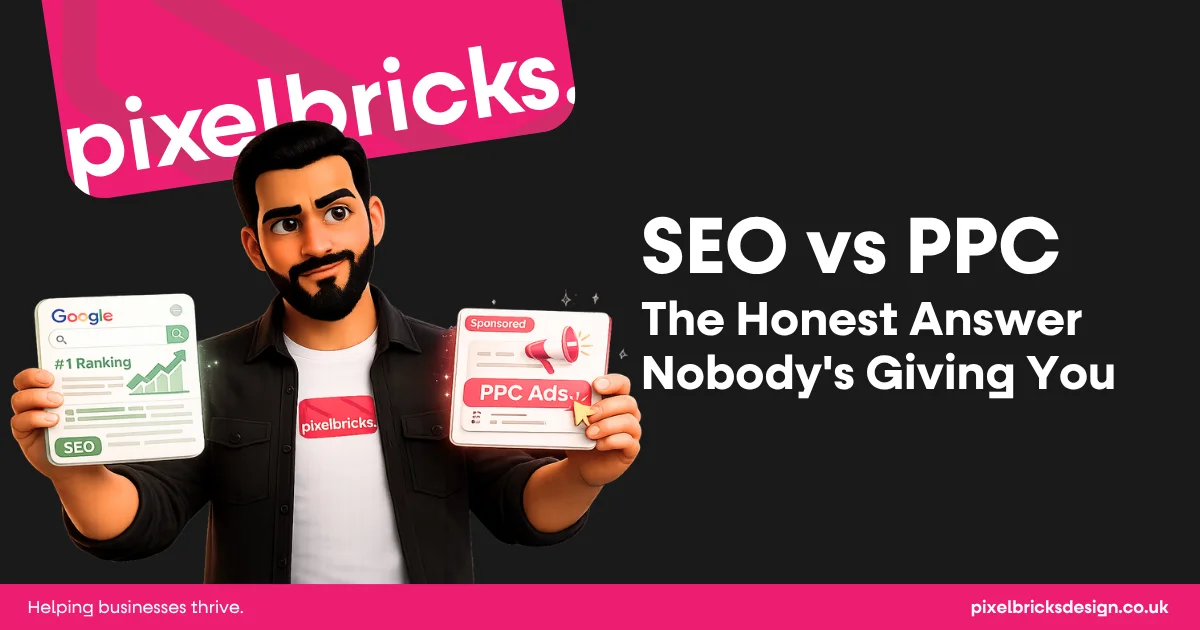
Every agency will tell you the same thing. SEO agencies will tell you PPC is expensive, short-term, and basically renting visibility. PPC agencies will tell you SEO is slow, unpredictable, and a gamble. Both of them are right. Both of them are also trying to sell you something.
So here's a version with no agenda attached.
What SEO actually is (and isn't)
SEO is the process of making your website show up in Google's unpaid results for the right searches. When someone types "web designer in London" and clicks on a result without it saying "Sponsored"… that's SEO at work.
The catch? It takes time. A lot of it.
Most businesses won't see meaningful results from SEO for at least six months. Competitive industries can take 12 months or more before you're ranking anywhere worth being. It's not a tap you turn on. It's more like planting a garden… you do the work, and eventually things grow. But you don't get tomatoes on day three.
The upside is that once you're ranking, the traffic is essentially free. And unlike PPC, it doesn't stop the moment you stop paying.
Part of that ongoing SEO investment usually involves building quality backlinks. If you want to shortcut the outreach side, Rhino Rank handles the legwork of sourcing relevant, high-quality links so you can focus on the rest of your strategy.
What PPC actually is (and isn't)
PPC (Pay-Per-Click) is paid advertising. Most commonly Google Ads. You bid on keywords, your ad appears at the top of results, and you pay every time someone clicks. In the UK, average cost-per-click across most small business sectors sits between £1.50 and £8.00 depending on your industry and location. London adds a 15-30% premium on top of that.
The upside is speed. Your ads can be live within hours. If you've got a new service to promote or you're launching a campaign around a specific time of year, PPC can put you in front of people immediately.
The downside is obvious: the moment you stop paying, you disappear. There's no residual value. No equity building up in the background.
The comparison you actually need
Here's the honest side-by-side that most articles bury in vague bullet points.
| SEO | PPC | |
|---|---|---|
| Time to results | 6-12+ months | Days to weeks |
| Cost model | Upfront investment, lower ongoing cost | Ongoing spend (stops when you stop) |
| Traffic when you pause | Continues (if maintained) | Drops to zero immediately |
| Best for | Long-term growth, compounding returns | New launches, seasonal peaks, fast testing |
| Typical UK monthly cost | £500–£2,000 (agency fees) | £500–£2,500+ ad spend, plus management |
| ROI timeline | Slow to start, compounds over time | Immediate but flat (doesn't grow on its own) |
| Keyword control | Indirect (Google decides your ranking) | Direct (you choose exactly what triggers ads) |
| Trust signals | Organic results seen as more credible | "Sponsored" label puts some people off |
| Competitive markets | Harder but doable with consistent effort | More expensive but still achievable |
| What you own | Rankings build with your site over time | Nothing (you rent the visibility) |
| Website requirement | Good content and technical foundations | Fast, clear landing page that converts |
When PPC makes more sense
There are situations where PPC is genuinely the smarter choice, and pretending otherwise doesn't help anyone.
You're a new business with no domain authority. SEO takes time to build trust with Google. A site that launched three months ago isn't going to rank for competitive terms any time soon. PPC gets you in front of people while you wait.
You've got something time-sensitive. A product launch, a sale, a seasonal service, a specific event. You can't wait six months for SEO to kick in. PPC is designed for exactly this.
You're testing a new service or market. Running a small PPC campaign tells you quickly whether people are actually searching for what you're offering. It's market research with a feedback loop. Cheaper than building out a whole SEO strategy for something that might not land.
Your competitors are dominating organic search. In some niches, the first page of Google is locked up by established players who've been doing SEO for years. PPC can still get you into position one, above all of them, if your budget allows.
When SEO makes more sense
You're playing a long game. If you're not in a rush and you want traffic that compounds over time, SEO is the better investment. A well-ranked blog post or service page can bring in enquiries for years without you touching it again.
You're in a low-to-medium competition niche. The harder the keywords are to rank for, the slower and more expensive SEO becomes. But for plenty of local service businesses (tradespeople, local consultants, niche specialists) the competition isn't actually that fierce if you approach it properly. As we covered in top tips for local SEO for service area businesses, local SEO can be surprisingly achievable with the right foundations.
You want to build something you own. PPC visibility belongs to Google. Organic rankings aren't guaranteed either, but they're built on your site, your content, your reputation. That has real value.
Your budget is limited and you're thinking long-term. PPC at low budgets often isn't very effective… you don't get enough volume to optimise properly. SEO with that same budget over 12 months can build something that pays off for years.
The honest answer: they work better together
This is what most small business owners miss.
PPC and SEO aren't competing strategies. They're different tools for different jobs. The smartest approach is usually to run PPC while your SEO builds in the background… so you're not sitting there for six months with no traffic, but you're also not relying on paid ads forever.
PPC also gives you data. You can see exactly which keywords convert, which landing pages work, which messages resonate. That information makes your SEO strategy smarter. You're not guessing what to rank for… you already know what people click on and buy from.
There's another thing that doesn't get said enough: neither works properly without a decent website underneath it. Sending paid traffic to a slow, confusing, or unconvincing site is like running ads for a restaurant with bad food. The traffic arrives, takes one look, and leaves. If you're not converting the visitors you already have, more of them won't fix it. That's true for SEO and PPC equally.
If you're not sure where to start on that side of things, 6 ways to make your website convert more customers is worth reading before you spend a penny on either channel.
I've started a Reddit discussion about this. Check it out >
What to actually do
If you're a small business with limited budget starting from scratch, here's the practical version.
Start with SEO. Build your foundations: a properly structured site, some solid content, local SEO basics sorted. It won't pay off immediately but every month it's getting stronger.
Use PPC tactically. If you've got a specific thing to promote, a quiet period to fill, or a new service to test… run a targeted campaign. Don't leave it running indefinitely without reviewing it.
Don't try to do both at full scale on a small budget. You'll spread too thin and do neither properly.
And whoever you hire to help… make sure you own your own Google Ads account and your own website. There are still agencies out there that hold your data hostage when you leave. Worth asking about before you sign anything. We touched on this in why backlink strategy needs a rebrand… the pattern of agencies gatekeeping your own data is more common than it should be.
Key Takeaways
FAQs About SEO vs PPC
Which is cheaper, SEO or PPC?
SEO tends to be cheaper over the long run, but it requires upfront investment and patience before it pays off. PPC costs are immediate and ongoing. For UK small businesses, both typically require a monthly budget of £500–£2,000 to do properly.
How long does SEO take to work?
Most businesses start seeing meaningful results between six and twelve months in. Competitive industries can take longer. It's not a quick fix… but once it works, it keeps working without you paying per click.
Can I do SEO and PPC at the same time?
Yes… and for many businesses it's the smartest approach. PPC brings traffic now while SEO builds in the background. The data from PPC campaigns can also sharpen your SEO strategy considerably.
Does a better website help with both SEO and PPC?
Absolutely. Google uses landing page quality as a ranking factor for both organic results and paid ads (it's called Quality Score in Google Ads). A faster, clearer, better-converting site lowers your cost-per-click and improves your organic rankings. It's the foundation that makes everything else work.